Porsche Taycan Range: Range Anxiety in an Electric Supercar?
Updated on 16.10.2026: Taycan 4 and GTS added, test figures from ADAC and ÖAMTC, new status on the electric 718 and the Tesla Model S.
With the Taycan, Porsche has shown that it doesn't just nail combustion engines - the Taycan is a true supercar, just as you'd expect from Stuttgart. But even Porsche faces the million-dollar question for EVs: "How far does it actually go?" Everything about the Porsche Taycan and its range in this blog post.
There are several electric supercars out there by now, but the Porsche Taycan stands on its own. That's simply because the Porsche identity can be found in every detail. It may sound abstract, but you get it the moment you sit down in the driver's seat. If you want to know what that feels like, you can rent the Porsche Taycan from us in Germany.
Key facts at a glance
- Officially (WLTP), the Porsche Taycan goes 313 to 421 miles (503 to 678 km) depending on the version. The rear-wheel-drive Taycan with the Performance Battery Plus goes furthest. EPA ratings for the US sedan run from 252 to 318 miles.
- In independent tests, it managed 354 miles (570 km) in the ADAC Ecotest and 313 miles (504 km) in winter (ÖAMTC). Drive it like a Porsche and you're looking at 220 to 250 miles.
- Charging: every version charges at up to 320 kW, from 10 to 80 percent in under 18 minutes.
- The biggest difference isn't the motors, it's the battery (82 or 97 kWh), speed and temperature.
- Seven versions of the sedan have been available since early 2025: Taycan, Taycan 4, 4S, GTS, Turbo, Turbo S and Turbo GT.
Table of Contents
- Key facts at a glance
- Porsche Taycan range: all models compared
- How far does the rear-wheel-drive Taycan really go?
- Porsche Taycan 4S: more range despite all-wheel drive?
- Turbo, Turbo S and Turbo GT: what's left of 390 miles?
- What affects the Taycan's range?
- How fast does the Porsche Taycan charge?
- Porsche Taycan: Stuttgart goes electric
- CarVia verdict: Porsche as brilliant as ever?
- Frequently asked questions about Porsche Taycan range

Porsche Taycan range: all models compared
Porsche has tightened a few screws since the launch in 2019 - the newest Taycan is more powerful, looks better and drives more efficiently. Porsche wasn't content with a mere facelift for the 2024 model update: the folks in Stuttgart completely reworked the drivetrain and battery.
Examples include the new cell chemistry, which lets the electric athlete boast up to 10% higher energy density. On top of that, the Taycan now pulls even more energy from regenerative braking than before - up to 400 kW instead of 290 kW (source: Porsche Newsroom). But that's just a taste of the many bigger and smaller modifications Porsche is using to compete with the crème de la crème of the electric world (source: ADAC).
If there were just one Porsche Taycan, this blog post would be over quickly. Instead, there are now seven versions of the Swabian electric sports car - not counting the Sport and Cross Turismo - starting with the base model with rear-wheel drive.
Model | Battery (net) | Power (with Launch Control) | 0-60 mph | WLTP range | Real-world range* |
Taycan (rear-wheel drive) | 82 kWh | 402 hp (408 PS) | 4.5 s | 313-367 mi (503-590 km) | approx. 220 mi (350 km) |
Taycan, Performance Battery Plus (rear-wheel drive) | 97 kWh | 429 hp (435 PS) | 4.5 s | up to 421 mi (678 km) | 354 mi / 570 km (ADAC Ecotest), 313 mi / 504 km (ÖAMTC winter) |
Taycan 4 (all-wheel drive) | 82 / 97 kWh | 402 / 429 hp | 4.4 s | 347 / 400 mi (559 / 643 km) | approx. 220-250 mi (350-400 km) |
Taycan 4S | 82 kWh | 456 hp, overboost 536 hp | 3.5 s | 295-346 mi (474-557 km) | approx. 185-250 mi (300-400 km) |
Taycan 4S, Performance Battery Plus | 97 kWh | 510 hp, overboost 590 hp | 3.5 s | 341-399 mi (549-642 km) | approx. 185-250 mi (300-400 km) |
Taycan GTS | 97 kWh | up to 690 hp (700 PS) | 3.1 s | up to 390 mi (628 km) | approx. 220-250 mi (350-400 km) |
Taycan Turbo | 97 kWh | 697 hp, overboost 871 hp | 2.5 s | 346-391 mi (557-630 km) | approx. 220-250 mi (350-400 km) |
Taycan Turbo S | 97 kWh | 764 hp, overboost 938 hp | 2.3 s | 346-391 mi (557-630 km) | approx. 220-250 mi (350-400 km) |
Taycan Turbo GT | 97 kWh | 777 hp, overboost 1,019 hp | 2.2 s | 328-344 mi (528-554 km) | approx. 185-220 mi (300-350 km) |
*Real-world range: measured values where tests exist, otherwise our estimate at a brisk pace. WLTP spans depend on wheels and equipment. 0-60 mph figures are Porsche's US figures with Launch Control (sources: Porsche, ADAC, ÖAMTC).
How far does the rear-wheel-drive Taycan really go?
Even with the "humblest" rear-wheel-drive Taycan, there are further trade-offs to make. Depending on how much money you spend, you get a bit more or a bit less battery capacity. There's 82 kilowatt-hours (kWh) and then 97 kWh. So that both can sprint from 0 to 60 mph in 4.5 seconds, the smaller version has 402 hp (408 PS) of power, while the motors of the larger variant already put out 429 hp (435 PS).
Top speed is 142 mph. But if you put your foot down, instead of a minimum of 27 kWh per 100 miles you'll quickly be using 32 kWh. If you're driving around with the smaller battery, WLTP says it'll take you 313 to 367 miles (503 to 590 km) - WLTP is the European test cycle, and it's more generous than the EPA. How far you really get varies depending on your driving style, load and whether you actually run the battery all the way down. It's certainly not 310 miles, though; around 220 miles (350 km) is far more likely - and if you drive a bit more spiritedly and switch off traction control for a few nice corners, it'll be noticeably less than that.
With the Performance Battery Plus it's a different story: Porsche quotes up to 421 miles (678 km) on the WLTP cycle, and ADAC, Germany's largest auto club, actually measured 354 miles (570 km) in its Ecotest, at 31.7 kWh per 100 miles. The Austrian auto club ÖAMTC still got 313 miles (504 km) in its 2025 winter test. For a sports car with over 400 hp, that's a statement - provided you don't drive it like a sports car. For comparison: the EPA rates the 2025 Taycan sedan at 252 to 318 miles depending on the battery, so the ADAC result sits right between the US and the European figure.
Since early 2025 there's also the Taycan 4: same power, but all-wheel drive, 4.4 seconds to 60 mph and 347 to 400 miles (559 to 643 km) on the WLTP cycle. So the second motor costs you around 20 miles (30 km) compared to the rear-wheel-drive car (source: Porsche Newsroom).
But since you charge from 10 to 80 percent in under 18 minutes at a fast charger, that's not so bad - provided, of course, that the station actually delivers 320 kW.
With the base spec and the small battery, the rear-wheel-drive Taycan already costs you over €101,000 in Germany. For an eco-conscious family car with enough room for child seats in the back, that's still okay these days, right? If that's still a bit too pricey for you, you can simply try out the electric Porsche in our car sharing in Munich. There, the sports car costs just €0.69 per minute.
What it's like to be out and about in the Taycan and constantly thinking about the next charging opportunity is something we found out for ourselves - more on charging further down.
Porsche Taycan 4S: more range despite all-wheel drive?
If you like to have everything under control, you're probably even better off with the Porsche Taycan 4S. In the 4S, the two synchronous motors send power to all 4 wheels. That lets you really use the power in corners, too - and just like the rear-wheel-drive version, there are 2 different versions here as well. The first again has an 82 kWh battery, the second 97 kWh.
The models accelerate from 0 to 60 mph in 3.5 seconds with Launch Control. The AWD variant with the 82 kWh battery makes do with 456 hp (462 PS), and in overboost mode it peaks at 536 hp (544 PS). So that the heavier version with the bigger battery can keep up, Porsche gave it 510 hp (517 PS) and, in boost, as much as 590 hp - almost 600 PS. With 4 driven wheels you get a top speed of 155 mph, 13 mph more than the base version.
Far more important is the range, though - and here the second motor costs you noticeably: with the small battery, WLTP allows 295 to 346 miles (474 to 557 km), with the bigger pack officially 341 to 399 miles (549 to 642 km). The rear-wheel-drive car goes around 20 miles further on the same battery. A range of 185 to 250 miles (300 to 400 km) is more realistic, though. If you estimate conservatively, you're guaranteed to be better off.
Turbo, Turbo S and Turbo GT: what's left of 390 miles?
The 3 most powerful versions of the Taycan are actually rather unfortunately named. After all, there's no turbocharger under the hood - yet the models offer insane power, with zero turbo lag.
In between, Porsche brought back the GTS in early 2025: up to 690 hp (700 PS) with Launch Control, 3.1 seconds to 60 mph and up to 390 miles (628 km) on the WLTP cycle - the all-rounder if the 4S is too tame for you and the Turbo too expensive.
The high-performance models all shine with the 97 kWh battery, but the ranges differ, sometimes massively. No wonder, when you take a closer look at the technical details of the drivetrain:
Model | Turbo | Turbo S | Turbo GT |
Power | 697 to 871 hp | 764 to 938 hp | 777 to 1,019 hp |
0-60 mph | 2.5 s | 2.3 s | 2.2 s |
Top speed | 161 mph | 161 mph | 180 mph |
WLTP range | 346-391 mi (557-630 km) | 346-391 mi (557-630 km) | 328-344 mi (528-554 km) |
For some inexplicable reason, Porsche even fitted the Turbo GT with motors totaling 777 hp (789 PS) - in overboost with Launch Control, output climbs to 1,019 hp (1,034 PS). That comes with a maximum torque of 915 lb-ft. For a car straight from the factory, that's pure madness.
According to WLTP, the "regular" Turbo and the Turbo S both manage 346 to 391 miles (557 to 630 km); the Turbo GT officially doesn't reach that range. Here it's over at 328 to 344 miles (528 to 554 km). But just like the less brutal versions of the Taycan, the cars will run out of steam well before that. Ranges from just under 220 to a maximum of 250 miles seem far more likely. Play with the throttle a bit too much and your battery will be dead much sooner - but that shouldn't surprise anyone.
What affects the Taycan's range?
The WLTP figure is a lab value, Europe's counterpart to the EPA rating and a more optimistic one. How far you really get comes down to five things above all:
- Speed: Drag grows with the square of your speed. Doing 100 mph instead of 75 on an unrestricted stretch of autobahn costs you directly in miles - and in a Taycan the temptation is huge.
- Temperature: Cabin heating and a cold battery cost the most in winter. The Technical University of Munich measured that cabin heating alone eats up to 31.9 percent of range, and the reduced recuperation in the cold another 21.7 percent (Steinstraeter, Heinrich, Lienkamp 2021). The ÖAMTC got 313 instead of 414 miles (504 instead of 667 km) out of the Taycan in winter, so roughly a quarter less.
- Battery: 82 or 97 kWh net. The Performance Battery Plus adds 53 to 56 miles (85 to 90 km) depending on the version and is standard on the GTS, Turbo, Turbo S and Turbo GT.
- Wheels and tires: Bigger wheels and sport tires cost noticeably. That's why the WLTP figures are given as a span - 313 to 367 miles is the same battery, just with different equipment.
- Drive mode and recuperation: In Range mode the Taycan dials back power and climate control. Recuperation recovers up to 400 kW, but only if you drive ahead instead of braking.
How fast does the Porsche Taycan charge?
Short answer: faster than almost anything else on the market. Thanks to its 800-volt system, the Taycan charges at suitable high-power chargers at up to 320 kW, from 10 to 80 percent in under 18 minutes (Porsche's figure at a battery temperature of 59°F / 15°C). ADAC measured a peak of 296 kW, and the high power holds until around 70 percent state of charge. On an 11 kW wallbox - a typical Level 2 charger - a full charge of the big battery takes around nine hours instead.
Porsche Taycan: Stuttgart goes electric
As early as 2015, Porsche announced that a production car would be developed based on the Mission E concept study. That eyebrows were raised and noses turned up is hardly surprising, especially since in 2015 only a fraction of today's charging points existed.
But Porsche CEO Oliver Blume wanted to aim even higher: alongside the fully electric drivetrain, the necessary technology for SAE Level 4 autonomous driving was to be built in during development - meaning a car that drives itself under defined conditions without the driver having to step in.
When the first Taycan Turbo with 500 kW and Taycan Turbo S with 560 kW models were launched in 2019, even Tesla's crown as the electric powerhouse wobbled. Suddenly the Americans had serious competition for the Model S.
Taycan: a name for Mission E
A perhaps surprising challenge was finding the name. A total of over 600 ideas were up for selection, from which marketing experts were to pick the one perfect name for the electric sedan.
That's said to have been anything but easy, since the proposals were written in over 20 languages. 2 native speakers each were consulted, and in the end Taycan was chosen. The name is made up of the Turkish words "Tay" and "Can", which roughly mean "foal" and "soul". On the one hand, that hints at a fresh start for the prancing horse in the middle of the Porsche crest. On the other, it fits perfectly with the car's slogan, "soul, electrified".
That the name can also be read in Japanese is a happy bonus - "taikan" can be translated as "physical experience". That suits the track-ready electric Porsche and the instant acceleration that slams you into your seat.
Porsche at a crossroads: electric Boxster & Cayman
Even the cult brand Porsche, which has set the benchmark for sports cars with the 911 for decades, isn't spared from increasing electrification. First came the Taycan, and in 2024 it was the Macan's turn. Even though the beloved 911 gets to keep its combustion engine, the little siblings are next in line.
With the 718, though, the schedule has slipped considerably: instead of 2025, Porsche now names 2028 as the first full production year for the electric Boxster and Cayman, with the premiere planned for 2027. In between there were reports that Porsche might keep building the combustion 718 after all or scrap the electric project entirely - according to Porsche, a combustion revival was never approved by the board, and the next 718 generation will be all-electric (source: AutoGuide).
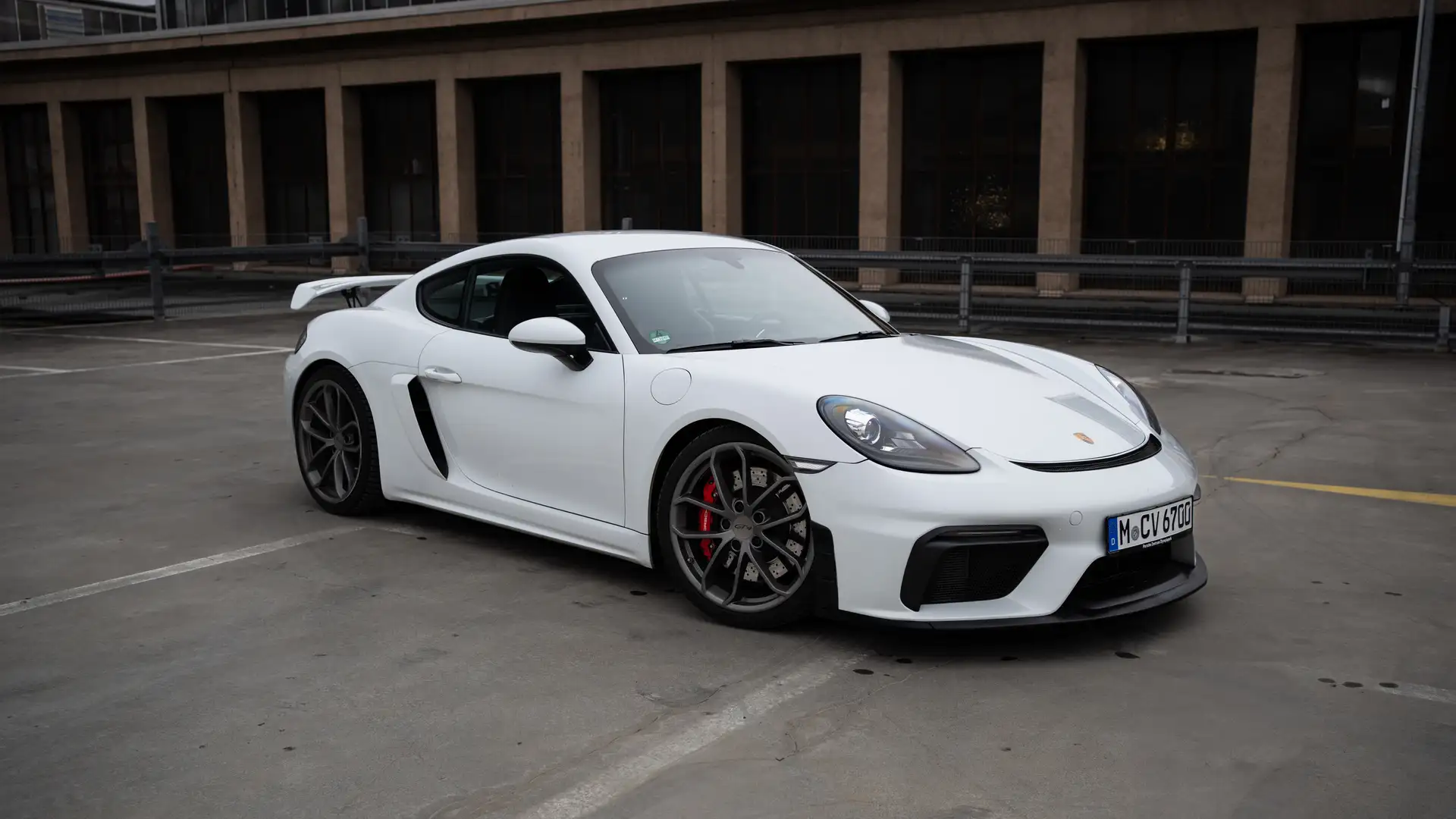
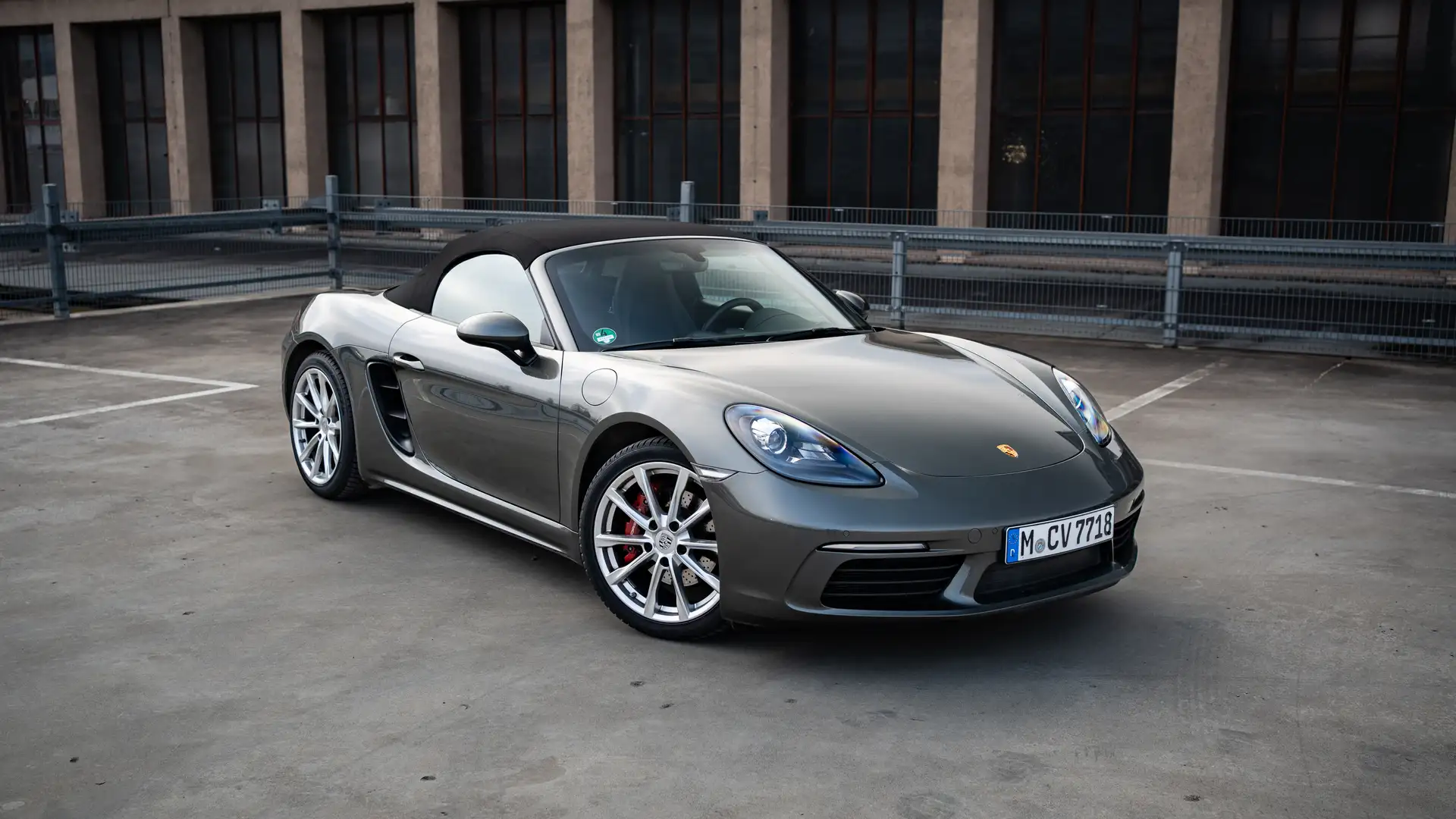
The rumor mill has been churning since the Mission R concept was unveiled in 2021, especially with plenty of disagreement about the looks of the coupe and convertible. After the new Boxster was spotted on a test drive in early 2024, it's now clear that it will at least share large parts of its front end with the Cayman. Until then, the 718 Cayman and Boxster with combustion engines remain the last of their kind - and you can still drive both with us.

CarVia verdict: Porsche as brilliant as ever?
With the Porsche Taycan, Porsche took on Tesla - and on a front that was previously unknown to the Stuttgart company. The (first and weakest) Model S beats the (first and weakest) Taycan in almost every respect in a direct comparison.
With the most powerful versions, the Model S Plaid and the Taycan Turbo GT, the differences are now minimal; in many areas the Turbo GT is actually significantly better. One small detail should be kept in mind, though: in Germany the Tesla cost just under €108,000, while the GT - not even in the Weissach version - sits at €240,000.
That duel is now history: Tesla is ending production of the Model S and Model X at the end of the second quarter of 2026, and Fremont will build Optimus robots instead (source: FOX / CNBC). That leaves the Taycan pretty much alone in its class - which doesn't make the price any prettier, but it does make the decision easier.
The most interesting thing, though, is still the everyday usability of the Taycan versions. Thankfully, the facelift also pushed ranges up thanks to bigger batteries, but Porsche's EV formula isn't perfect yet. And for the electric 718s we'll have to wait until 2028.
If you absolutely want to try a Porsche 718 with a combustion engine one more time - with or without a roof -, a 911 or different versions of the Taycan, just head straight to our homepage. Through our booking form you'll quickly find out which cars are available when - and at a fair price.
Frequently asked questions about Porsche Taycan range
Depending on the version, 313 to 421 miles (503 to 678 km) on the WLTP cycle; EPA ratings for the US sedan run from 252 to 318 miles. In independent tests, the rear-wheel-drive Taycan with the Performance Battery Plus managed 354 miles (570 km) in the ADAC Ecotest and 313 miles (504 km) in winter (ÖAMTC). If you drive it hard, count on 220 to 250 miles.
The rear-wheel-drive Taycan with the Performance Battery Plus: up to 421 miles (678 km) on the WLTP cycle, 318 miles EPA. Every extra motor and every extra horsepower costs miles - the Turbo GT sits at 328 to 344 miles (528 to 554 km).
Around 20 to 25 percent compared to WLTP. The ÖAMTC measured 313 instead of 414 miles (504 instead of 667 km) in its winter test. The main reasons are cabin heating and a cold battery; according to the Technical University of Munich, heating alone costs up to 31.9 percent.
From 10 to 80 percent in under 18 minutes at a 320 kW charger. On an 11 kW wallbox, the big battery needs around nine hours for a full charge.
Yes. You can rent the Taycan at our stations in Germany, with delivery to your hotel or to the airport, for example Munich (MUC) or Frankfurt (FRA). A US or Canadian driver's license is accepted without an international permit. In Munich you can also try it in our car sharing from €0.69 per minute.
Articles that might interest you

BMW i8 - The Underrated Hybrid Sports Car

Porsche 911 (992) Carrera S Cabriolet: How It Compares to the 991

Audi R8 V10 Spyder Review - Power, Sound and Brutal Depreciation

Is the Porsche Cayman GTS 4.0 with Its Flat-Six Just as Good as a GT4?

Porsche 911 Turbo S - The Best Car in the World?

Our BMW M4 Competition (G82) Review - A True Sports Car?
Porsche 911 GT3 Review: Our Verdict After 18,600 Miles
Tesla Model 3: Range in Winter

Tesla Model Y Winter Range Test: How Far Does It Really Go in the Cold?